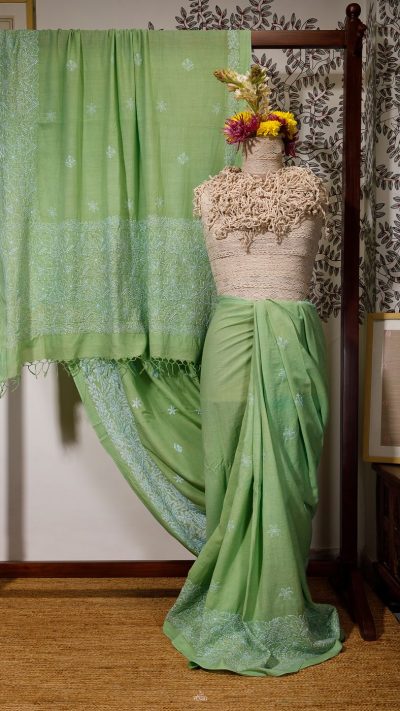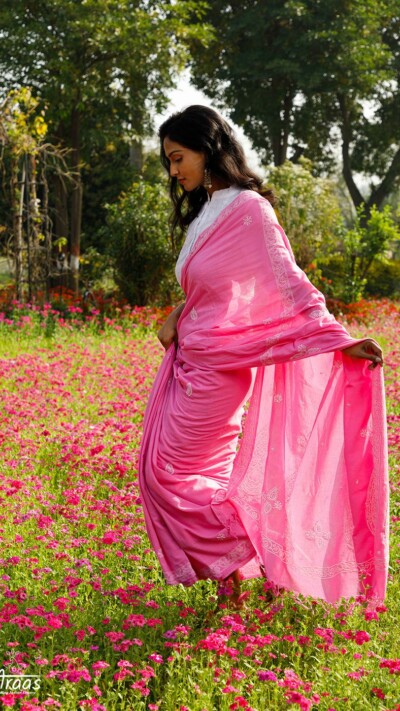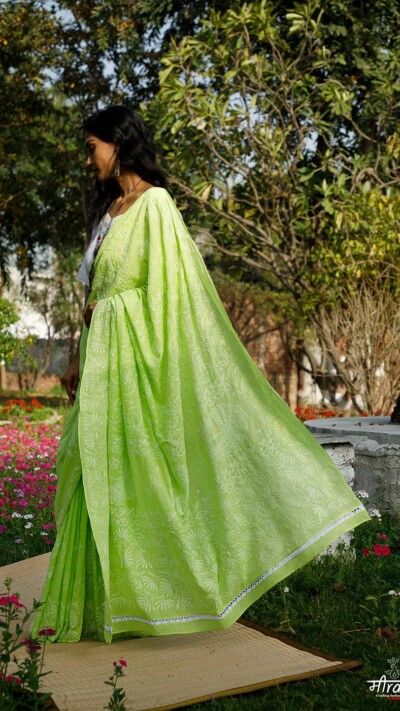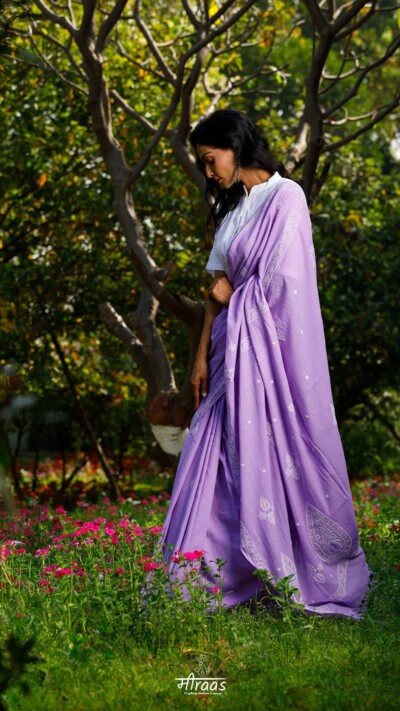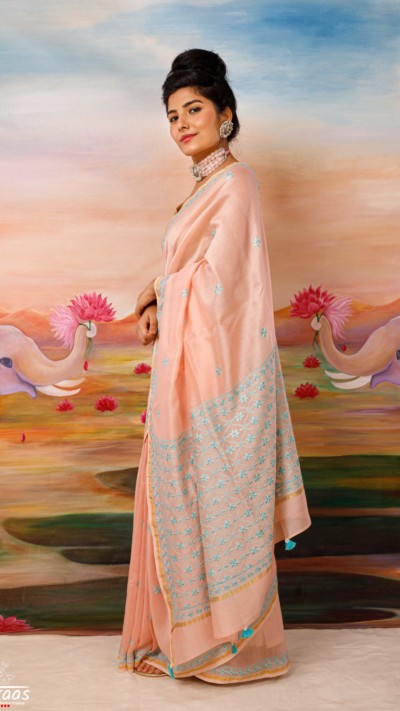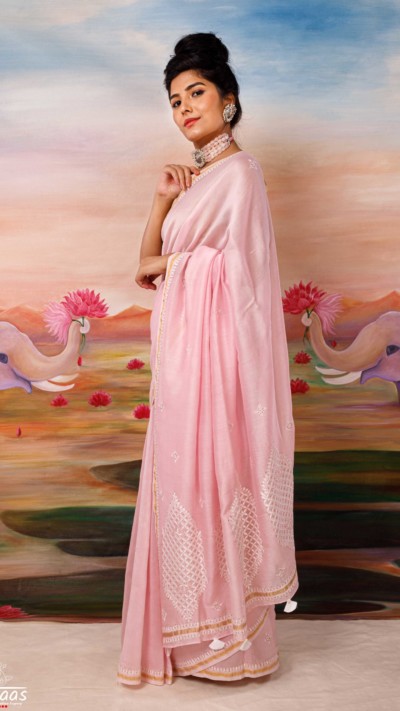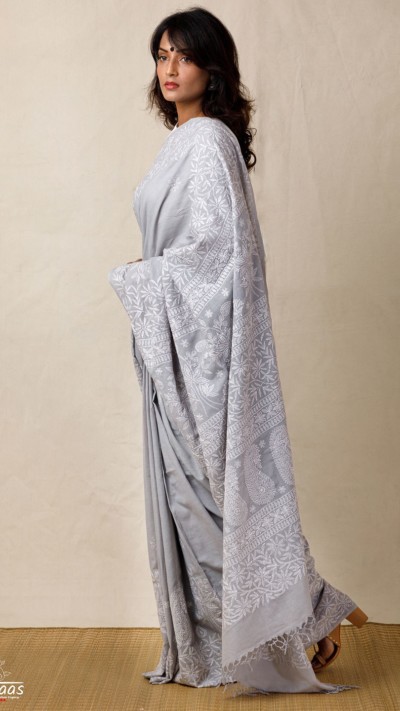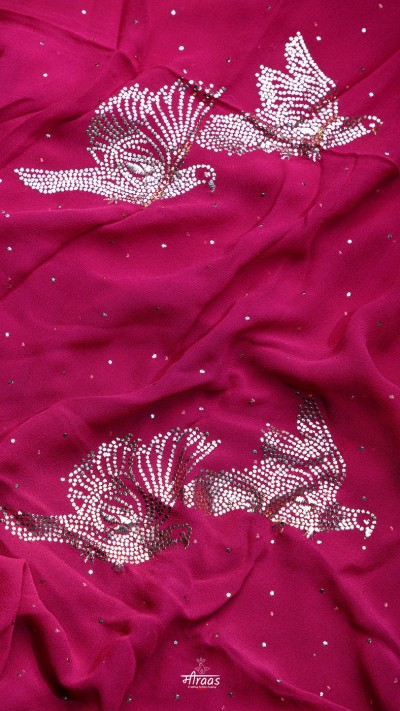
Artisan Skill Enhancement: The artisan unit that has embroidered this Chikankri Saree had never worked on a saree before or done skilled stitch work. They had never even worked on any pure fabric & only did "shadow" "phanda" stitches for fast moving Chikan goods. Such nuanced work enhanced their skill and gives them better chance of earning more.
Slow Layout of Embroidery: The embroidery layout is in typical style of an Heirloom saree with more designs and even Shadow work. This breaks away from the allover simple Tepchi embroidery that is the norm of fast moving Chikan work.
Non Motorised Amber Charkha Spun Fabric yarn.
Handwoven high count Cotton Saree
Azo Free filtered dyeing
Khayal (moodboard): Rajnigandha collection is inspired by Everyday Effortless charm of saree draping from 1970s-80s, when the ladies of our homes used to drape sarees for everyday chores, & not just for occasions. There was a certain careless abandon in this style, that made the drapes very relatable and one with the wearer, which is an emotion missing now from saree draping. Since the collection finds its muse in 1970s middle cinema heroines, like Vidya Sinha, the names are kept reminiscent of the romance of those ages!! Petrichor is the fragrance of Monsoon very dear to lovers of Slow Living, that is evocative of the simple yet soulful era!!
Poshaak (about the saree):
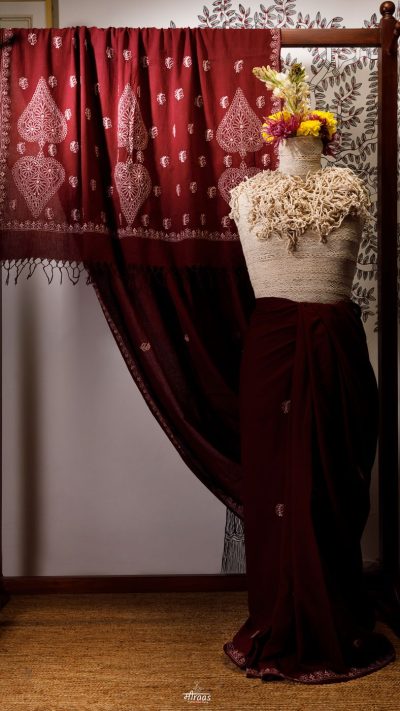
Beautiful & rare Peacock Motif along with a stunning floral shadow motif and Lotus creepers come together to celebrate this beautiful Chikankari saree. To create this one of a kind Tepchi with Shadow embroidery layout, we re-imagined this saree in the style of design layout that is usually reserved for pure georgette Chikankari sarees; only, we gave this a twist suited best for good quality Tepchi embroidery. Instead of an allover same embroidery pattern, that is normal with Tepchi, we broke the palla layout into interesting panels to include more nuanced motifs & even included a Shadow stitch motif. This makes the layout of the saree unique, and allows the artisans to enhance their skill in Tepchi embroidery. Please remember, that only constant practise and challenges makes crafts perfect.
We absolutely love Tepchi Chikankari. The delicate Tepchi is quite literally Summer embroidered on your saree.
However, off late the Tepchi we have started getting in markets is a travesty. You will be lucky to find a really good quality Tepchi for office or casual wear. We have worked very hard on this saree to create a fantastic Tepchi & some shadow work masterpiece, along with Handwoven fabric!! This is a true collector's delight.
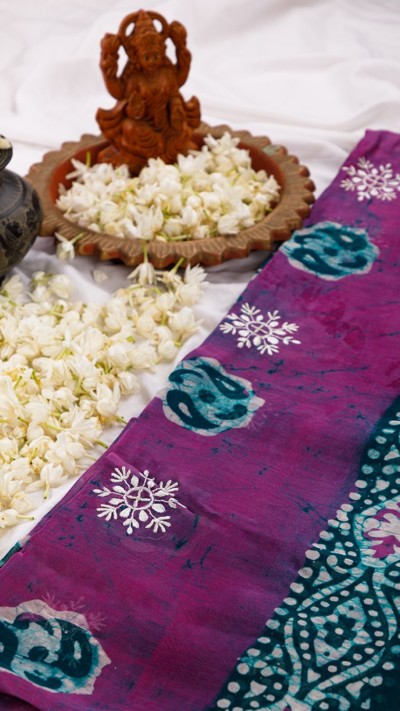
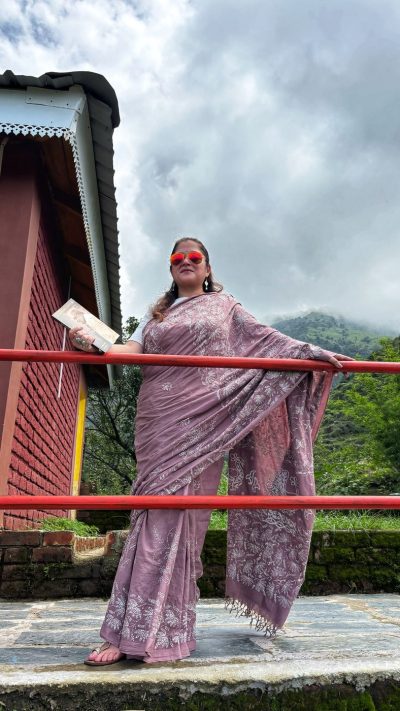
The unconventional dark Old Rose (Brown with very faint hints of Pink) hue is stunning, all season fresh & outstanding , making it a perfect & must have Chikankari wear.
Creating a Chikankari saree on Handspun Handwoven Cotton weave was always our dream. We have been successful in finding the perfect sustainable drape for our delicately embroidered sarees.
It is a perfect light office/lunch/brunch/casual wear saree, yet one that will make heads turn. The drape is perfect for any weather.
IMP: Please Note, this is a Khadi Cotton saree, which is dyed after the embroidery. There will be non uniformity in colour gradation. This is the charm of Khadi and its differentiating factor.
Styling Tip: Wear with Rajnigandha Crop Top
Artisan Skill Enhancement: The artisan unit that has embroidered this Chikankri Saree had never worked on a saree before or done skilled stitch work. They had never even worked on any pure fabric & only did "shadow" "phanda" stitches for fast moving Chikan goods. Such nuanced work enhanced their skill and gives them better chance of earning more.
Slow Layout of Embroidery: The embroidery layout is in typical style of an Heirloom saree with more designs and even Shadow work. This breaks away from the allover simple Tepchi embroidery that is the norm of fast moving Chikan work.
Non Motorised Amber Charkha Spun Fabric yarn.
Handwoven high count Cotton Saree
Azo Free filtered dyeing
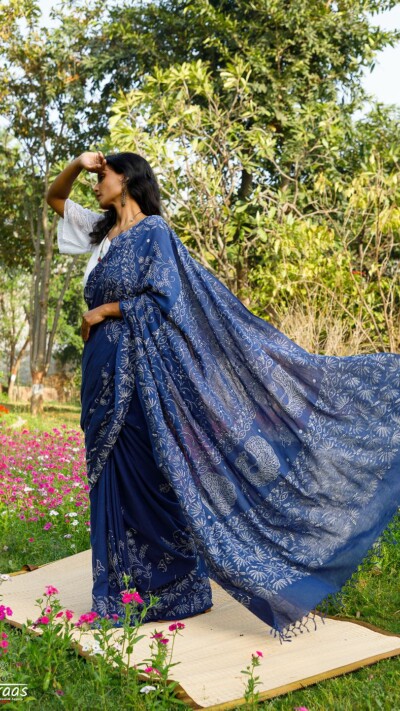
Khayal (moodboard): Rajnigandha collection is inspired by Everyday Effortless charm of saree draping from 1970s-80s, when the ladies of our homes used to drape sarees for everyday chores, & not just for occasions. There was a certain careless abandon in this style, that made the drapes very relatable and one with the wearer, which is an emotion missing now from saree draping. Since the collection finds its muse in 1970s middle cinema heroines, like Vidya Sinha, the names are kept reminiscent of the romance of those ages!! Badra (Monsoon Clouds) is a slice of life name, that is evocative of the simple yet soulful era!!
Poshaak (about the saree):
Beautiful & rare Peacock Motif along with a stunning floral shadow motif and Lotus creepers come together to celebrate this beautiful Chikankari saree. To create this one of a kind Tepchi with Shadow embroidery layout, we re-imagined this saree in the style of design layout that is usually reserved for pure georgette Chikankari sarees; only, we gave this a twist suited best for good quality Tepchi embroidery. Instead of an allover same embroidery pattern, that is normal with Tepchi, we broke the palla layout into interesting panels to include more nuanced motifs & even included a Shadow stitch motif. This makes the layout of the saree unique, and allows the artisans to enhance their skill in Tepchi embroidery. Please remember, that only constant practise and challenges makes crafts perfect.
We absolutely love Tepchi Chikankari. The delicate Tepchi is quite literally Summer embroidered on your saree.
However, off late the Tepchi we have started getting in markets is a travesty. You will be lucky to find a really good quality Tepchi for office or casual wear. We have worked very hard on this saree to create a fantastic Tepchi & some shadow work masterpiece, along with Handwoven fabric!! This is a true collector's delight.
The unconventional Indigo hue is stunning, all season fresh & outstanding , making it a perfect & must have Chikankari wear.
Creating a Chikankari saree on Handspun Handwoven Cotton weave was always our dream. We have been successful in finding the perfect sustainable drape for our delicately embroidered sarees.
This is a new design introduced this year. It is a perfect light office/lunch/brunch/casual wear saree, yet one that will make heads turn. The drape is perfect for any weather.
IMP: Please Note, this is a Khadi Cotton saree, which is dyed after the embroidery. There will be non uniformity in colour gradation. This is the charm of Khadi and its differentiating factor.
Styling Tip: Wear with Rajnigandha Crop Top
The very first CONCEPT SAREE in Chikankari. This saree has Rumi Darwaza and sacred Fish Motifs of Awadh, all originally crafted by Meiraas.
UNIQUE MEIRAAS BLOCKS - Art created from scratch. Motif Blocks drawn & chiseled by hand in ancient style. This gives more challenging & creative work to Block Artisans, who were being eliminated by many designers in favour of digital tracing.
RESHAM CHIKANKARI (HAND EMBROIDERY PRACTISED SINCE ANCIENT AGE)
Khayal (moodboard):
Built by Nawab Asaf Ud Daulah, the Rumi Darwaza, is the architectural leitmotif of Lucknow city. While the Darwaza is based on Turkey's Sublime Porte, our Rumi is much more magnificent & imposing as a structure, due to the skilled Indian "shilpkaars" that have perfected the art of astonishing monuments & mega structures since India's millenia old history.
Today, Rumi Darwaza, stands like an old King on beautifully cobbled streets of Lucknow, welcoming & opening the gates to Old City of Lucknow. The Fish Emblem is part of the state seal of UP. Fish is a scared symbol for both Hindus (Matsya Avatar) & Shia community in Lucknow.
POSHAAK (about the dress):
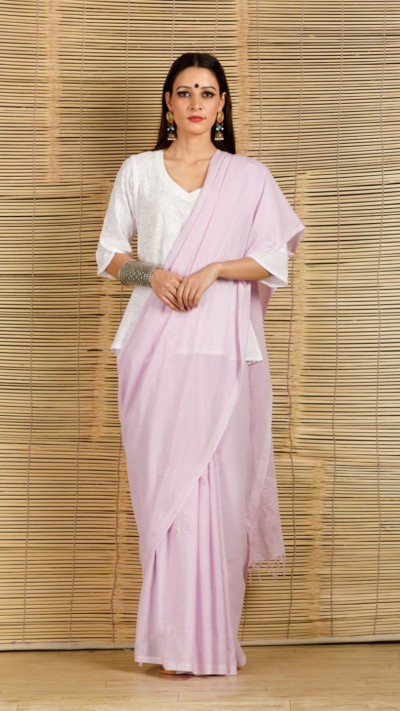
This 3 D art saree is made on Amber Charkha spun & Handwoven soft Cotton, and dyed in Azo Free dyes in soft Lavendar shade.
Depicting the signature architectural brilliance of Lucknow, this saree has Chikankari motifs of Rumi Darwaza & Fish Emblem of Nawabs. A conversation starter & showstopper saree by Meiraas, this is a true collector's delight.
Artisan Skill Enhancement: Very fine quality motif work, that involves more skilled work quality done with lesser filaments. The design layout also facilitates more skilled workmanship.
Khayal (moodboard):"Rajnigandha Collection was born out of my love of 70s effortless and relatable genre of Hindi Cinema, and the look of the heroines of such films, who felt closer to the women in my family & around me – my mother, my aunts, my teachers – all of whom were heroines in their own life, and were changing the societal mindset, to accept women who knew their mind, could go out & work, or homemakers who needed personal time, have a life and defined choices, while taking their family along in this journey. It was an interesting time!!
Rajnigandha was especially chosen for Chikankari sarees, because they were heavily worn by women of all age groups in Lucknow, light worked ones and heavier Tepchi ones in pretty sorbet & pastel shades.
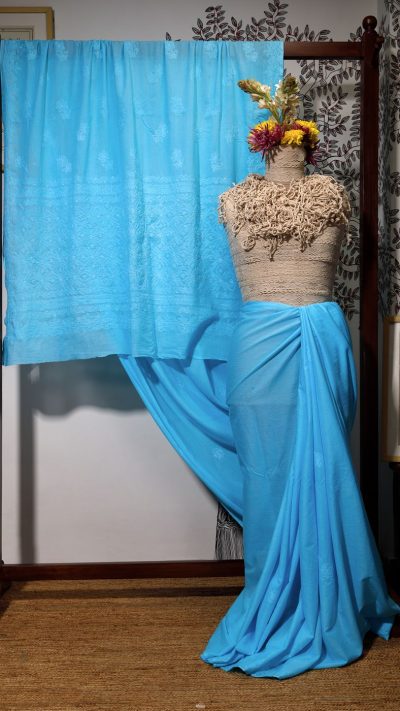
The collection is also my heart collective, as it involves Artisan Skill Enhancement at each level, along with using good quality handwoven cotton fabric, all of which is fast disappearing from Chikankari everyday sarees."- Vidhi Rastogi, Head of Creative, MeiraasPoshaak (about the saree): This lovely Bakhiya (shadow) Phanda (French knot) embroidery fresh Blue saree has a unique border display with multiple border usage on palla and a very fine border with keel kangan stitch, running through the saree.
Extremely fine quality shadow embroidery on palla, enhances the look of this beautiful saree. The rest of body has Frangipani blossoms embroidered on its body, making it one of a kind saree.
It is a perfect light office/lunch/brunch/casual wear saree, yet one that will make heads turn. The drape is perfect for any weather.
Imp: Please Note, this is a Khadi Cotton saree, which is dyed after the embroidery. There will be non uniformity in colour gradation. This is the charm of Khadi and its differentiating factor.
Note: Colours might show slight difference in different light. That is due to nature of colour, light under which it is viewed, and various factors. Please bear these factors in mind when making the selection.
Artisan Skill Enhancement: Very fine quality motif work, that involves more skilled work quality done with lesser filaments. The design layout also facilitates more skilled workmanship.
Khayal (moodboard):"Rajnigandha Collection was born out of my love of 70s effortless and relatable genre of Hindi Cinema, and the look of the heroines of such films, who felt closer to the women in my family & around me – my mother, my aunts, my teachers – all of whom were heroines in their own life, and were changing the societal mindset, to accept women who knew their mind, could go out & work, or homemakers who needed personal time, have a life and defined choices, while taking their family along in this journey. It was an interesting time!!
Rajnigandha was especially chosen for Chikankari sarees, because they were heavily worn by women of all age groups in Lucknow, light worked ones and heavier Tepchi ones in pretty sorbet & pastel shades.
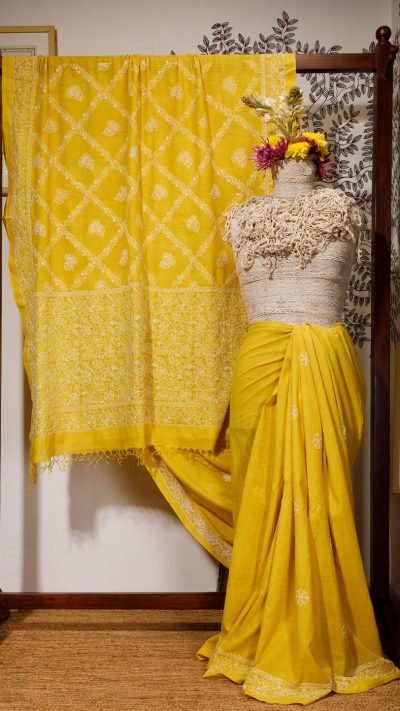
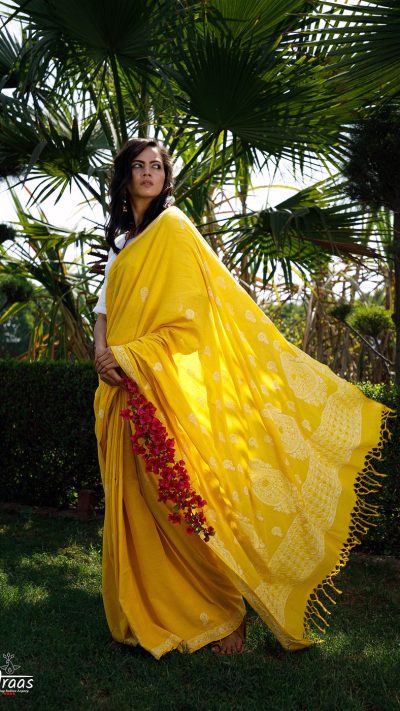
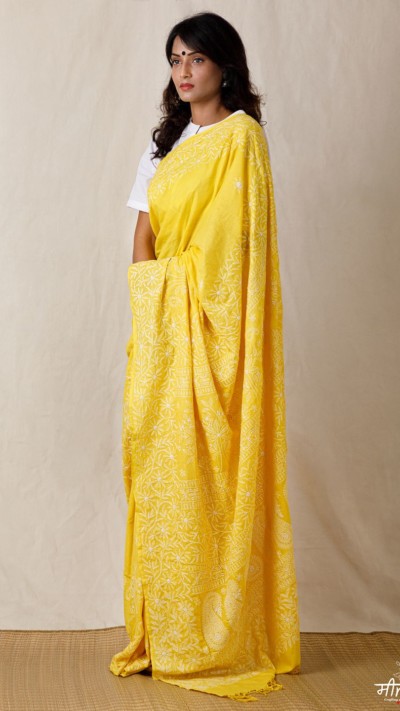
The collection is also my heart collective, as it involves Artisan Skill Enhancement at each level, along with using good quality handwoven cotton fabric, all of which is fast disappearing from Chikankari everyday sarees."- Vidhi Rastogi, Head of Creative, MeiraasPoshaak (about the saree): This lovely Sandalwood Yellow Chikankari saree has a very unique palla design, that features, Orma stitch along with shadow and phanda, with very intense and skilled designing.
The palla, further opens into a diagonal criss cross pattern of embroidery, reminiscent of sarees that were popular in the craft in 1980s-90s, in good quality cotton. The border detailing is done very painstakingly with well done shadow embroidery.
Extremely fine quality of embroidery on each motif of the saree, enhances its beautiful look. The rest of body has floral blossoms embroidered on its body, making it one of a kind saree.
It is a perfect light office/lunch/brunch/casual wear saree, yet one that will make heads turn. The drape is perfect for any weather.
Imp: Please Note, this is a Khadi Cotton saree, which is dyed after the embroidery. There will be non uniformity in colour gradation. This is the charm of Khadi and its differentiating factor.
Note: Colours might show slight difference in different light. That is due to nature of colour, light under which it is viewed, and various factors. Please bear these factors in mind when making the selection.
Artisan Skill Enhancement: Very fine quality motif work, that involves more skilled work quality done with lesser filaments. The design layout also facilitates more skilled workmanship.
Khayal (moodboard):"Rajnigandha Collection was born out of my love of 70s effortless and relatable genre of Hindi Cinema, and the look of the heroines of such films, who felt closer to the women in my family & around me – my mother, my aunts, my teachers – all of whom were heroines in their own life, and were changing the societal mindset, to accept women who knew their mind, could go out & work, or homemakers who needed personal time, have a life and defined choices, while taking their family along in this journey. It was an interesting time!!
Rajnigandha was especially chosen for Chikankari sarees, because they were heavily worn by women of all age groups in Lucknow, light worked ones and heavier Tepchi ones in pretty sorbet & pastel shades.
The collection is also my heart collective, as it involves Artisan Skill Enhancement at each level, along with using good quality handwoven cotton fabric, all of which are fast disappearing from Chikankari everyday sarees." - Vidhi Rastogi, Head of Creative, MeiraasPoshaak (about the saree): Wine is a beautiful deep plum hued Chikankari saree, that needs very little to dress it up or down for various occasions.
It is embroidered with intricate Paan motif, an endearing iconography of Lucknow, that is reminiscent of the favourite mouth freshener Luckhnavis are addicted to. Rest of the saree has small floral bootis all over.
Wear it for office with silver jewellery, or brunch with friends with well chosen Tribal Jewels, while you order yourself a glass of Merlot.
Please Note: The saree is shot under studio light, colour will vary slightly when seen indoors & when seen outdoors in full sun. This is the nature of the colour.
It is a perfect light office/lunch/brunch/casual wear saree, yet one that will make heads turn. The drape is perfect for any weather.
Artisan Skill Enhancement: Very fine quality motif work, that involves more skilled work quality done with lesser filaments. The design layout also facilitates more skilled workmanship.
Novel design motif of scallop in Chikankari, conceptualised and created exclusively by Meiraas
Khayal (moodboard):"Rajnigandha Collection was born out of my love of 70s effortless and relatable genre of Hindi Cinema, and the look of the heroines of such films, who felt closer to the women in my family & around me – my mother, my aunts, my teachers – all of whom were heroines in their own life, and were changing the societal mindset, to accept women who knew their mind, could go out & work, or homemakers who needed personal time, have a life and defined choices, while taking their family along in this journey. It was an interesting time!!
Rajnigandha was especially chosen for Chikankari sarees, because they were heavily worn by women of all age groups in Lucknow, light worked ones and heavier Tepchi ones in pretty sorbet & pastel shades.
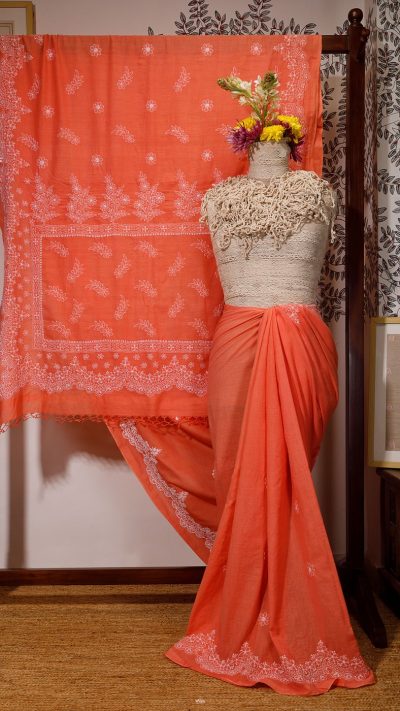
The collection is also my heart collective, as it involves Artisan Skill Enhancement at each level, along with using good quality handwoven cotton fabric, all of which is fast disappearing from Chikankari everyday sarees."- Vidhi Rastogi, Head of Creative, MeiraasPoshaak (about the saree): This lovely Bakhiya (shadow) Phanda (French knot) embroidered Coral Orange saree has Meiraas Exclusive Scallop motif, that runs all through the border and palla of the saree. This unique motif gives a delightful toran like appearance to the design layout of the saree.
The palla, further has a rectangle window layout, inside and outside of which we have used a mix of beautiful floral motifs to bring out the feeling of Tesu season, when not just the flaming orange blossoms of Holi, but also various flowers around them are in full bloom.
Extremely fine quality shadow embroidery on palla, enhances the look of this beautiful saree. The rest of body has floral blossoms embroidered on its body, making it one of a kind saree.
It is a perfect light office/lunch/brunch/casual wear saree, yet one that will make heads turn. The drape is perfect for any weather.
Imp: Please Note, this is a Khadi Cotton saree, which is dyed after the embroidery. There will be non uniformity in colour gradation. This is the charm of Khadi and its differentiating factor.
Note: Colours might show slight difference in different light. That is due to nature of colour, light under which it is viewed, and various factors. Please bear these factors in mind when making the selection.
Artisan Skill Enhancement: Very fine quality motif work, that involves more skilled work quality done with lesser filaments. The design layout also facilitates more skilled workmanship.
Khayal (moodboard):"Rajnigandha Collection was born out of my love of 70s effortless and relatable genre of Hindi Cinema, and the look of the heroines of such films, who felt closer to the women in my family & around me – my mother, my aunts, my teachers – all of whom were heroines in their own life, and were changing the societal mindset, to accept women who knew their mind, could go out & work, or homemakers who needed personal time, have a life and defined choices, while taking their family along in this journey. It was an interesting time!!
Rajnigandha was especially chosen for Chikankari sarees, because they were heavily worn by women of all age groups in Lucknow, light worked ones and heavier Tepchi ones in pretty sorbet & pastel shades.
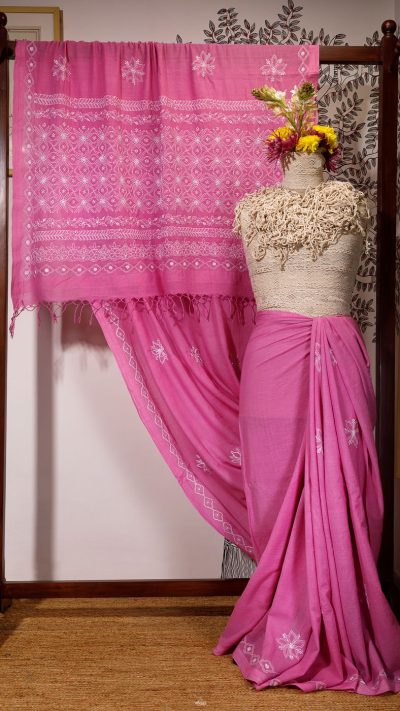
The collection is also my heart collective, as it involves Artisan Skill Enhancement at each level, along with using good quality handwoven cotton fabric, all of which is fast disappearing from Chikankari everyday sarees."- Vidhi Rastogi, Head of Creative, MeiraasPoshaak (about the saree): This lovely Bakhiya (shadow) Phanda (French knot) embroidery Pink saree has a unique border display with multiple border usage on palla and a very fine border with keel kangan stitch, running through the saree.
Extremely fine quality shadow embroidery on palla, enhances the look of this beautiful saree. The rest of body has Frangipani blossoms embroidered on its body, making it one of a kind saree.
It is a perfect light office/lunch/brunch/casual wear saree, yet one that will make heads turn. The drape is perfect for any weather.
Imp: Please Note, this is a Khadi Cotton saree, which is dyed after the embroidery. There will be non uniformity in colour gradation. This is the charm of Khadi and its differentiating factor.
Note: Colours might show slight difference in different light. That is due to nature of colour, light under which it is viewed, and various factors. Please bear these factors in mind when making the selection.
Artisan Skill Enhancement: Very fine quality motif work, that involves more skilled work quality done with lesser filaments. The design layout also facilitates more skilled workmanship.
Khayal (moodboard):"Rajnigandha Collection was born out of my love of 70s effortless and relatable genre of Hindi Cinema, and the look of the heroines of such films, who felt closer to the women in my family & around me – my mother, my aunts, my teachers – all of whom were heroines in their own life, and were changing the societal mindset, to accept women who knew their mind, could go out & work, or homemakers who needed personal time, have a life and defined choices, while taking their family along in this journey. It was an interesting time!!
Rajnigandha was especially chosen for Chikankari sarees, because they were heavily worn by women of all age groups in Lucknow, light worked ones and heavier Tepchi ones in pretty sorbet & pastel shades.
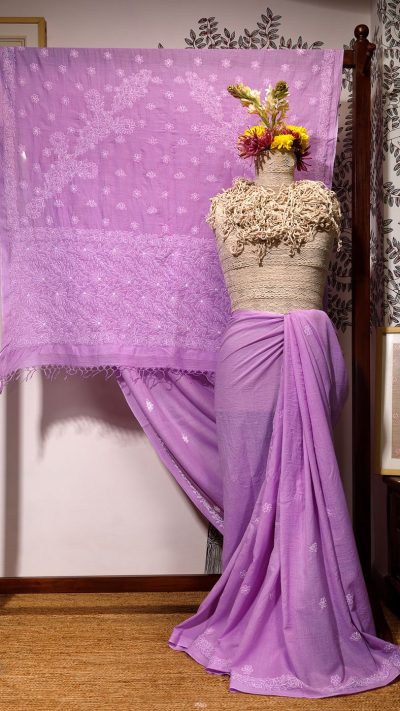
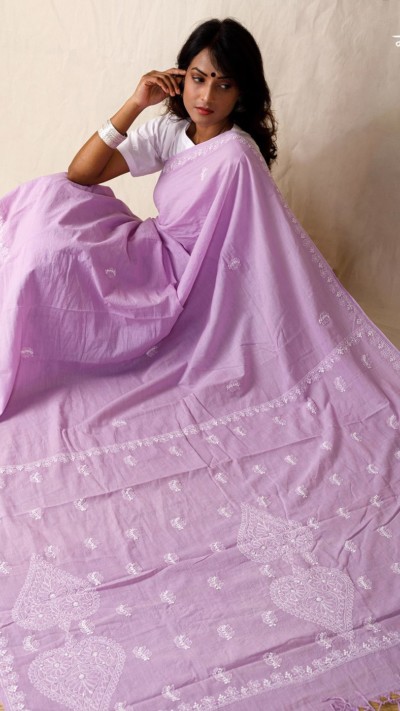
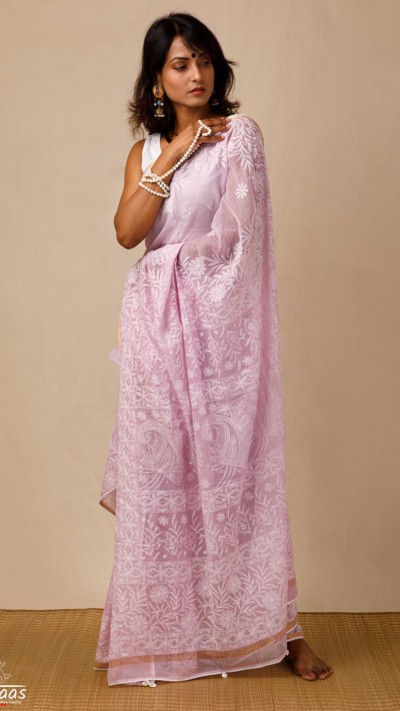
The collection is also my heart collective, as it involves Artisan Skill Enhancement at each level, along with using good quality handwoven cotton fabric, all of which is fast disappearing from Chikankari everyday sarees."- Vidhi Rastogi, Head of Creative, MeiraasPoshaak (about the saree): This lovely Bakdhiya Phanda lavendar colour saree has a dense, yet very neatly embroidered, shadow palla of floral embroidery. Two branches of flowers emerge in a diagonal pattern to give more body & design to the palla layout.
Rest of the body has a running border and floral bootis scattered all through.
It is a perfect light office/lunch/brunch/casual wear saree, yet one that will make heads turn. The drape is perfect for any weather.
Imp: Please Note, this is a Khadi Cotton saree, which is dyed after the embroidery. There will be non uniformity in colour gradation. This is the charm of Khadi and its differentiating factor.
Note: Colours might show slight difference in different light. That is due to nature of colour, light under which it is viewed, and various factors. Please bear these factors in mind when making the selection.
Artisan Skill Enhancement: Very fine quality motif work, that involves more skilled work quality done with lesser filaments. The design layout also facilitates more skilled workmanship.
Khayal (moodboard):"Rajnigandha Collection was born out of my love of 70s effortless and relatable genre of Hindi Cinema, and the look of the heroines of such films, who felt closer to the women in my family & around me – my mother, my aunts, my teachers – all of whom were heroines in their own life, and were changing the societal mindset, to accept women who knew their mind, could go out & work, or homemakers who needed personal time, have a life and defined choices, while taking their family along in this journey. It was an interesting time!!
Rajnigandha was especially chosen for Chikankari sarees, because they were heavily worn by women of all age groups in Lucknow, light worked ones and heavier Tepchi ones in pretty sorbet & pastel shades.
The collection is also my heart collective, as it involves Artisan Skill Enhancement at each level, along with using good quality handwoven cotton fabric, all of which are fast disappearing from Chikankari everyday sarees."- Vidhi Rastogi, Head of Creative, MeiraasPoshaak (about the saree):
The Paan saree has a very ornate motif work of Paan leaf & other floral jaal. This dense and beautiful motif has been embroidered to make a stunning Palla and one side heavier border that will come on the pleats, with shadow and phanda stitches.
The other side of the border is sleeker, thereby giving an illusion of balance and a flattering form, when the saree is draped.
Little scattered floral bootis carry through the saree.
It is a perfect light office/lunch/brunch/casual wear saree, yet one that will make heads turn. The drape is perfect for any weather.
Note: Colours might show slight difference in different light. That is due to nature of colour, light under which it is viewed, and various factors. Please bear these factors in mind when making the selection.
The motifs used in this saree are generally used for Pure Georgette sarees. In the local language of the artisans they called "Pure ka Boota" (meaning expensive motif). The motifs generally used for everyday Cotton Sarees are unskilled and are referred to as "chaalu kaam" (basic work) in their local parlance. The usage of this motif gave them an opportunity to work upon designs that they generally never get, thereby enhancing their skill set.
Jaali Stitch - fast vanishing from all artisans skill set, the Jaali stitch now remains a cynosure of premium Chikankari units only. The bargain basement embroidery market has completely devolved the artisan skill in Chikankari. We got them back to practising Jaali stitch by commissioning the same on Rajnigandha saree. (please refer to last image for reference, as initial photos did not have Jaali. The last image is an indoor mobile phone click to show jaali).
Khayal (moodboard):"Rajnigandha Collection was born out of my love of 70s effortless and relatable genre of Hindi Cinema, and the look of the heroines of such films, who felt closer to the women in my family & around me – my mother, my aunts, my teachers – all of whom were heroines in their own life, and were changing the societal mindset, to accept women who knew their mind, could go out & work, or homemakers who needed personal time, have a life and defined choices, while taking their family along in this journey. It was an interesting time!! Rajnigandha was especially chosen for Chikankari sarees, because they were heavily worn by women of all age groups in Lucknow, light worked ones and heavier Tepchi ones in pretty sorbet & pastel shades. The collection is also my heart collective, as it involves Artisan Skill Enhancement at each level, along with using good quality handwoven cotton fabric, all of which has completely disappeared from Chikankari everyday sarees."- Vidhi Rastogi, Head of Creative, MeiraasPoshaak (about the saree): An oblong Cypress Boota, a rare find, anoints itself on this beautiful Chikankari saree, that we choose to call MadhuMaalti. The motif is extremely rare, and has beautiful & very rare Jaali stitch done in cotton thread, a rarity now in everyday Chikankari sarees.
It is a beautiful Pink hued saree, that needs very little to dress it up or down for various occasions.
Wear it for office with silver jewellery, or brunch with friends with well chosen Tribal Jewels.
This is Amber Charkha spun (non motorised) & Handwoven soft Cotton from West Bengal. It is embroidered with intricate Cypress motif, a rare motif to be found in Lucknow, with intricate workmanship and most importantly Jaali embroidery (please refer to last image). Rest of the saree has small floral bootis all over.
It is a perfect light office/lunch/brunch/casual wear saree, yet one that will make heads turn. The drape is perfect for any weather.
Artisan Skill Enhancement: The artisan unit that has embroidered this Chikankri Saree had never worked on a saree before or done skilled stitch work. They had never even worked on any pure fabric & only did "shadow" "phanda" stitches for fast moving Chikan goods. Such nuanced work enhanced their skill and gives them better chance of earning more.
Slow Layout of Embroidery: The embroidery layout is in typical style of an Heirloom saree with more designs and even Shadow work. This breaks away from the allover simple Tepchi embroidery that is the norm of fast moving Chikan work.
Non Motorised Amber Charkha Spun Fabric yarn.
Handwoven high count Cotton Saree
Azo Free filtered dyeing
Khayal (moodboard): Rajnigandha collection is inspired by Everyday Effortless charm of saree draping from 1970s-80s, when the ladies of our homes used to drape sarees for everyday chores, & not just for occasions. There was a certain careless abandon in this style, that made the drapes very relatable and one with the wearer, which is an emotion missing now from saree draping. Since the collection finds its muse in 1970s middle cinema heroines, like Vidya Sinha, the names are kept reminiscent of the romance of those ages!! Purwaai (Cool Easterly Breeze) is a slice of life name, that is evocative of the simple yet soulful era!!
Poshaak (about the saree):
Beautiful & rare Peacock Motif along with a stunning floral shadow motif and Lotus creepers come together to celebrate this beautiful Chikankari saree. To create this one of a kind Tepchi with Shadow embroidery layout, we re-imagined this saree in the style of design layout that is usually reserved for pure georgette Chikankari sarees; only, we gave this a twist suited best for good quality Tepchi embroidery. Instead of an allover same embroidery pattern, that is normal with Tepchi, we broke the palla layout into interesting panels to include more nuanced motifs & even included a Shadow stitch motif. This makes the layout of the saree unique, and allows the artisans to enhance their skill in Tepchi embroidery. Please remember, that only constant practise and challenges makes crafts perfect.
We absolutely love Tepchi Chikankari. The delicate Tepchi is quite literally Summer embroidered on your saree.
However, off late the Tepchi we have started getting in markets is a travesty. You will be lucky to find a really good quality Tepchi for office or casual wear. We have worked very hard on this saree to create a fantastic Tepchi & some shadow work masterpiece, along with Handwoven fabric!! This is a true collector's delight.
The Vibrant Lime Green hue is uplifting & outstanding , making it a perfect & must have Chikankari wear.
Creating a Chikankari saree on Handspun Handwoven Cotton weave was always our dream. We have been successful in finding the perfect sustainable drape for our delicately embroidered sarees.
This is a new design introduced this year. It is a perfect light office/lunch/brunch/casual wear saree, yet one that will make heads turn. The drape is perfect for any weather.
IMP: The model is 5ft 7.5 inches and is with 1.5 inches approx heels in the shoot.
Styling Tip: Wear with Rajnigandha Crop Top
The motifs used in this saree are generally used for Pure Georgette sarees. In the local language of the artisans they called "Pure ka Boota" (meaning expensive motif). The motifs generally used for everyday Cotton Sarees are unskilled and are referred to as "chaalu kaam" (basic work) in their local parlance. The usage of this motif gave them an opportunity to work upon designs that they generally never get, thereby enhancing their skill set.
Jaali Stitch - fast vanishing from all artisans skill set, the Jaali stitch now remains a cynosure of premium Chikankari units only. The bargain basement embroidery market has completely devolved the artisan skill in Chikankari. We got them back to practising Jaali stitch by commissioning the same on Rajnigandha saree. (please refer to last image for reference, as initial photos did not have Jaali. The last image is taken indoors with mobile phone to show jaali).
Khayal (moodboard):"Rajnigandha Collection was born out of my love of 70s effortless and relatable genre of Hindi Cinema, and the look of the heroines of such films, who felt closer to the women in my family & around me – my mother, my aunts, my teachers – all of whom were heroines in their own life, and were changing the societal mindset, to accept women who knew their mind, could go out & work, or homemakers who needed personal time, have a life and defined choices, while taking their family along in this journey. It was an interesting time!!
Rajnigandha was especially chosen for Chikankari sarees, because they were heavily worn by women of all age groups in Lucknow, light worked ones and heavier Tepchi ones in pretty sorbet & pastel shades.
The collection is also my heart collective, as it involves Artisan Skill Enhancement at each level, along with using good quality handwoven cotton fabric, all of which has completely disappeared from Chikankari everyday sarees."- Vidhi Rastogi, Head of Creative, MeiraasPoshaak (about the saree): An oblong Cypress Boota, a rare find, anoints itself on this beautiful Chikankari saree, that we choose to call Black Currant. The motif is extremely rare, and has beautiful & very rare Jaali stitch done in cotton thread, a rarity now in everyday Chikankari sarees.
It is a beautiful Lavender hued saree, that needs very little to dress it up or down for various occasions.
Wear it for office with silver jewellery, or brunch with friends with well chosen Tribal Jewels.
This is Amber Charkha spun (non motorised) & Handwoven soft Cotton from West Bengal. It is embroidered with intricate Cypress motif, a rare motif to be found in Lucknow, with intricate workmanship and most importantly Jaali embroidery (please refer to last image). Rest of the saree has small floral bootis all over.
It is a perfect light office/lunch/brunch/casual wear saree, yet one that will make heads turn. The drape is perfect for any weather.
Artisan Skill Enhancement: The motifs used in this saree are generally used by non premium work units for Viscose or Pure Georgette sarees. In their local language they called "Pure ka Boota" (meaning expensive motif). The motifs generally used for everyday Cotton Sarees are unskilled and are referred to as "chaalu kaam" (basic work) in their local parlance. The usage of this motif gave them an opportunity to work upon designs that they generally never get.
Azo Free Dyes
Khayal (moodboard):"Rajnigandha Collection was born out of my love of 70s effortless and relatable genre of Hindi Cinema, and the look of the heroines of such films, who felt closer to the women in my family & around me – my mother, my aunts, my teachers – all of whom were heroines in their own life, and were changing the societal mindset, to accept women who knew their mind, could go out & work, or homemakers who needed personal time, have a life and defined choices, while taking their family along in this journey. It was an interesting time!!
Rajnigandha was especially chosen for Chikankari sarees, because they were heavily worn by women of all age groups in Lucknow, light worked ones and heavier Tepchi ones in pretty sorbet & pastel shades.
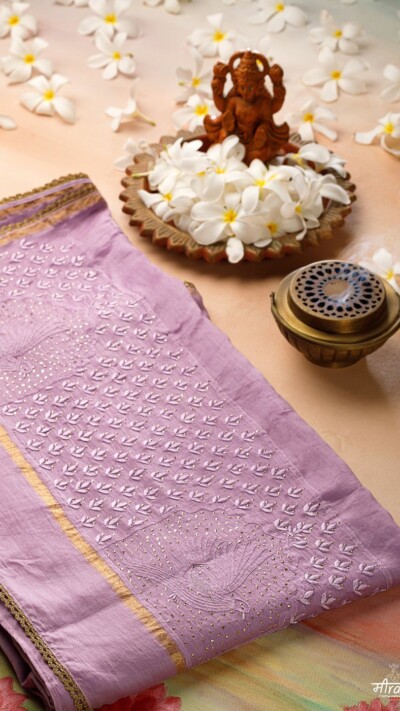
The collection is also my heart collective, as it involves Artisan Skill Enhancement at each level, along with using good quality handwoven cotton fabric, all of which has completely disappeared from Chikankari everyday sarees." - Vidhi Rastogi, Head of Creative, MeiraasPoshaak (about the saree): We have named this saree Jamuni. This hue is one of the favourite ones in Meiraas. Jamun or Indian Java Plum is a fruit indigenous to Jambudwipa or India Subcontinent. We grew up on a diet of its lassi & shake that had this beautiful lilac colour, so pleasing and fresh to the eyes and senses!!
This is Amber Charkha spun (non motorised) & Handwoven soft Cotton from West Bengal. It is embroidered with intricate Paan motif, an endearing motif of Lucknow, that is reminiscent of the favourite mouth freshener Luckhnavis are addicted to. Rest of the saree has small floral bootis all over.
It is a perfect light office/lunch/brunch/casual wear saree, yet one that will make heads turn. The drape is perfect for any weather.
P.S: This saree shade is soft very Pastel Lilac.
Artisan Skill Enhancement: Very fine quality motif work, that involves more skilled work quality done with lesser filaments. The design layout also facilitates more skilled workmanship.
Khayal (moodboard):"Rajnigandha Collection was born out of my love of 70s effortless and relatable genre of Hindi Cinema, and the look of the heroines of such films, who felt closer to the women in my family & around me – my mother, my aunts, my teachers – all of whom were heroines in their own life, and were changing the societal mindset, to accept women who knew their mind, could go out & work, or homemakers who needed personal time, have a life and defined choices, while taking their family along in this journey. It was an interesting time!!
Rajnigandha was especially chosen for Chikankari sarees, because they were heavily worn by women of all age groups in Lucknow, light worked ones and heavier Tepchi ones in pretty sorbet & pastel shades.
The collection is also my heart collective, as it involves Artisan Skill Enhancement at each level, along with using good quality handwoven cotton fabric, all of which is fast disappearing from Chikankari everyday sarees."- Vidhi Rastogi, Head of Creative, MeiraasPoshaak (about the saree): Dussehri is back! Our bestseller that launched in 2021 for the first time, and has been in constant production and demand since then.
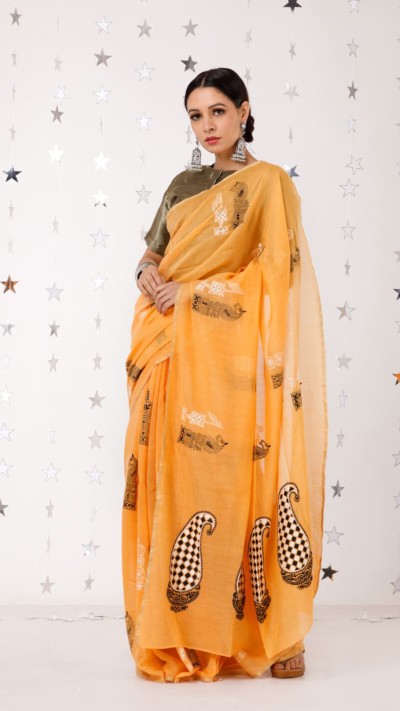
Dussehri saree has lovely Bakhiya (shadow) Phanda (French knot) embroidery on brilliant Mango yellow of the inside of Dussehri mango. The saree has a very fine border display, and a palla with trellis patteren. Above that, stunning paisley motifs of Dussehri have been printed. This paisley motif is very intricately detailed and embroidered.
Extremely fine quality shadow embroidery on palla, enhances the look of this beautiful saree. The rest of body has floral bootis embroidered on its body, making it one of a kind saree.
It is a perfect light office/lunch/brunch/casual wear saree, yet one that will make heads turn. The drape is perfect for any weather.
Note: Colours might show slight difference in different light. That is due to nature of colour, light under which it is viewed, and various factors. Please bear these factors in mind when making the selection.